Sunday, July 22, 2018

Responding to Janus, Part II

Last month, we wrote a brief summary of the SCOTUS decision of Janus v AFSCME. Since the decision, we have more time to reflect on how this right-wing court affects us as workers and as union members. With our reflections, we call for more assertive actions, especially locally, to strengthen our union in Texas.

1. The Court framed its decision as a First Amendment cause. The Court is wrong. We can address this as Texans.

The Court effectively overturned an important 1977 court decision (Abood v. Detroit Board of Education if you want to learn about that background) and argued that the First Amendment's protection of free speech prohibits public employee unions from charging a mandatory fee for the costs of representation. In Texas, we don't feel the effect of mandatory union fees for representing, but in otherwise union-friendly states, the effect of union collective bargaining is somewhat mixed in some facets and clear in others. According to The Brookings Institute (a conservative think tank), "collective bargaining rights lead to substantial increases in union presence and modest increases in wages" while "evidence on the effect of collective bargaining on public employee retirement benefits is much scarcer."

The collective bargaining act was seen as a free speech act, and Janus argued that he should not be forced to use his "speech" (union fees) though he is rewarded by the union's bargaining. However, the Court's minority dissent notes that unions do not inhibit the freedom of speech of members or non-members. While labor unions have a right to equitably represent all workers in a bargaining act, labor unions are, by law, the exclusive representatives of workers. This means that workers cannot have two labor unions representing them within the same working situation (you can imagine what a Detroit factory would look like with two working unions representing the floor, attempting to bargain with Ford; thus, the law permits only one union representing all workers). 

This singular representation is not unique to unions. We do the same in our communities where we all represent ourselves collectively in the voting machine for our taxes (note: this is ideal, of course, and we are not arguing that our voting system is either fair or equitable, especially in Texas. But let's pretend). As a taxing "collective," we cannot declare one day that as a result of differences with a government body that we should be able to avoid taxes. 

But as Bill Fletcher explains:
In the case of labor unions, they have been granted by law the right and duty to represent workers in a given economic jurisdiction—a bargaining unit. Workers in the public sector are not obligated to join the union but the compromise that was established, and been in operation for 41 years in many states that permit public sector unionism, was that those who choose not to join contribute towards representation costs. Thus, an individual worker who decides not to join the union may, nevertheless, face an issue for which they need representation. Representation costs money. A case may go to arbitration, for instance, which can be very expensive. There may be issues that have to be litigated in court. Indeed, an issue may need to go to a legislative body. These steps can be very expensive. The Supreme Court majority knows this and, essentially, what they said today is that they do not give a damn.
As Texans, we can address this easily:

  1. Explain to your colleagues that this was not about free speech. This is about how collective bargaining helps all workers. 
  2. Learn about collective bargaining and have a conversation with your local Texas legislator and senator. Yes, most of our legislative representatives are anti-labor, but our silence only encourages demagogues like Abbot and Patrick .
  3. Look at immediate history. The massive teacher strikes this year in West Virginia, Kentucky, Oklahoma, Arizona, Colorado and North Carolina have all taken place in “right to work” states like Texas, and this common fact was likely no coincidence. Workers in “right to work” states tend to have lower salaries and fewer benefits. Remind your local legislator.

2. Let's See a Perspective of the Impact -- Public Sector Unions

The court's decision certainly continues a national trend towards attacking labor-sector unions, such as in Illinois and Wisconsin, where since 2010, union membership declined 38 percent after the attacks on unions by Gov Walker and the Legislature (for a good resource of current news on labor issues such as happening in Wisconsin, see LaborNotes.org). Yet, the international union movement is larger than public-sector, while our national (and state) hostility toward labor-sector union has been part of our lives for decades. Moshe Marvit summarizes this:
the Janus decision will only directly impact less than half of the labor movement. This is because the ruling only applies to public-sector workers: federal, state and local government employees. However, federal employees (including postal employees) have long been under so-called “right to work,” so Janus will have minimal direct impact on them.
So, as Texans, we can address this:
  1. Be proactively engaged as a union. More than paying dues, be verbal, physical present. Specifically,
  2. Be present for Board of Trustees meetings: start at least once a year and remind the Board that you are a union member
  3. Meet your local legislative representative. Local has power while federal representatives are weak. Write your Texas legislator and senator and remind them how our union protects us as employees and strengthens us as citizens. Let them know that our union is very alive
  4. Inform other college employees about our union's efforts. Recruit other members to be paying union members.

3. On the other Hand, Understand that Some Populations will be Harder than Others ... Read: than Whites. Duh.

As Miles Kampf-Lassin argues, national public-sector unions disproportionately empower Black women, "this class of hyper-exploited workers is poised to be hit hardest by the anti-union ruling."
Source: Economic Policy Institute
While public-sector labor has facilitated Black women moving into the middle class, the ugly truth is that, on average, African-American women have to work seven months longer to receive the same pay as white men. The Janus decision further exacerbates that economic disparity. This discussion of color, unions, and education needs to be discussed elsewhere.

Here, we recommend:
  1. We need to hear more voices of Black women and men, Latinx women and men, and all disenfranchised workers in the college. Their stories often stun us. Our union chapter is open to all, but we see too many white voices and representation, which makes it especially important to listen. 
  2. We very pointedly want to understand real racial equity in the college at every corner: administration, faculty, and staff. For example, we call for a Freedom of Information Act request for hiring status, hiring persistence, and salary at LSCS. Though some tools show salaries for University of Houston and Houston Community College, no open data are available for LSCS.
  3. Trust Black Women.

4. Remember Who Represents Who: Texas Senator Ted Cruz

The Liberty Justice Center, one of the parties that represented Janus in court, received $800,000 from a policy institute funded by Richard Uihlein, an anti-union megadonor, according to tax forms reviewed by OpenSecrets. Uihlein is an Illinois businessman who has spent millions of dollars supporting Republican candidates such as Sen.Ted Cruz (R-Texas).

This is not a surprise, but as Texans, we have a responsibility to 
  1. Inform (repeatedly) Senator Cruz how his poise against workers affects us, and
  2. Connect with other Houstonians resisting Senator Cruz's agenda against people of color, migrants, workers, and everything that AFT stands for.
Postscript: As of 20 July, Mark Janus has left from his public-service position ... to work for the Liberty Justice Center, making even more money.
“Once again it’s clear that this court case was never about Mark Janus, but about billionaires like Bruce Rauner and big-money corporate funders launching a political attack on the freedom of working people to speak up together through a strong union,” AFSCME Council 31 spokesman Anders Lindall said. “While IPI tries to dupe workers into quitting their union, AFSCME members will continue doing what they’ve always done: providing important public services and building their union to speak up for themselves, their families and communities.”

Additional Reading

Compa, L. (2014). "An Overview of Collective Bargaining in the United States." Digital Commons.

Semuels, A. (2018). "Is This the End of Public-Sector Unions in America?" The Atlantic. 

Tang, A. (2018). "Life After Janus." [see whole 81-page PDF]

Monday, July 9, 2018

Post-Mortem of May's Houston Education Rally

Teachers take to the streets of Houston to defend public education

On May 19th, 2018, educators throughout Harris County congregated near Discovery Green for the "Texas Public Education Rally." Co-sponsored by AFT, the "rally" was not advertised as a protest, demonstration, or anything looking like a strike, as we know educators do not have the legal right to strike in Texas. The Facebook invitation explained:
We are proud to announce that on May 19th Texas AFT, Mike Collier, and Texans for Public Education will be holding a Rally for Public Education for all teachers, parents, students, and all those who care about public education across the state of Texas. Join us at Discovery Green in Houston as we stand up for a first-class public education system and hold our leaders accountable.
Mike Collier is a candidate for Lt Governor and will run against Lt Governor Daniel Patrick. Collier's "issues" page has a fluffy claim that education is a "highest priority" but includes little detail except that he is opposed to standardized testing and that higher education should be affordable.

Texans for Public Education are a very imprecise advocacy group who are "a group of people who are sick of what the politicians are doing with our school system, so we're taking it back using something they understand very well."

The intended day for the "rally" was the day after the shooting at Sante Fe High School, and the discourse sharply moved to a question of "safety." We will address realities of school safety in a future posts. Here, we want to return to the "rally" in Houston and its insufficiency to impress neither the taxpayers nor the politicians.

We suppose that Texans could build some critical mass similar to educators in West Virginia or Colorado or North Carolina or Arizona where they decisively used effective solidarity and effective communication to persuade the community that neoliberal politicians' decades of education budget and policies have demonstrated ... again ... that neoliberalism is always a poison pill for the community.

But Texans shouldn't hold their breaths.

Seth Uzman explains that Texan educators have multiple disadvantages compared to other states:

  1. The part-time Legislature, meeting only every two years, while bureaucrats of SBOE and THECB maintain daily hours. 
  2. Second, in any right-to-work state with no collective bargaining rights, striking has potentially significant penalties for militant teachers. Duh.
  3. "Aggravating the situation is the state’s cruelly stupid mechanism for funding teachers’ benefits. Texas is one of 15 states that doesn’t allow teachers to pay into Social Security, leaving them instead with a poorly organized pension fund through the state’s Teacher Retirement System." 
We want to discuss these other issues including the lean towards a privatized pension fund. We also need to review the state and court hostility toward laborers. We need to discuss the collaboration of community colleges and the THECB.

Actions like the rally for public education may have value in bringing together and energizing a group of people, but only if there's a significant next step that presses the need for face-to-face meetings with legislators. Because we know that as long as rallies take place outside of work hours, outside of legislative sessions, outside of the the earshot of the SBOE and the THECB, that those with power aren't listening. It will take more sustained action to be heard. The State of Texas is a well-organized oligarchy and each educator must become more direct, effective, and energized against it.


Saturday, June 30, 2018

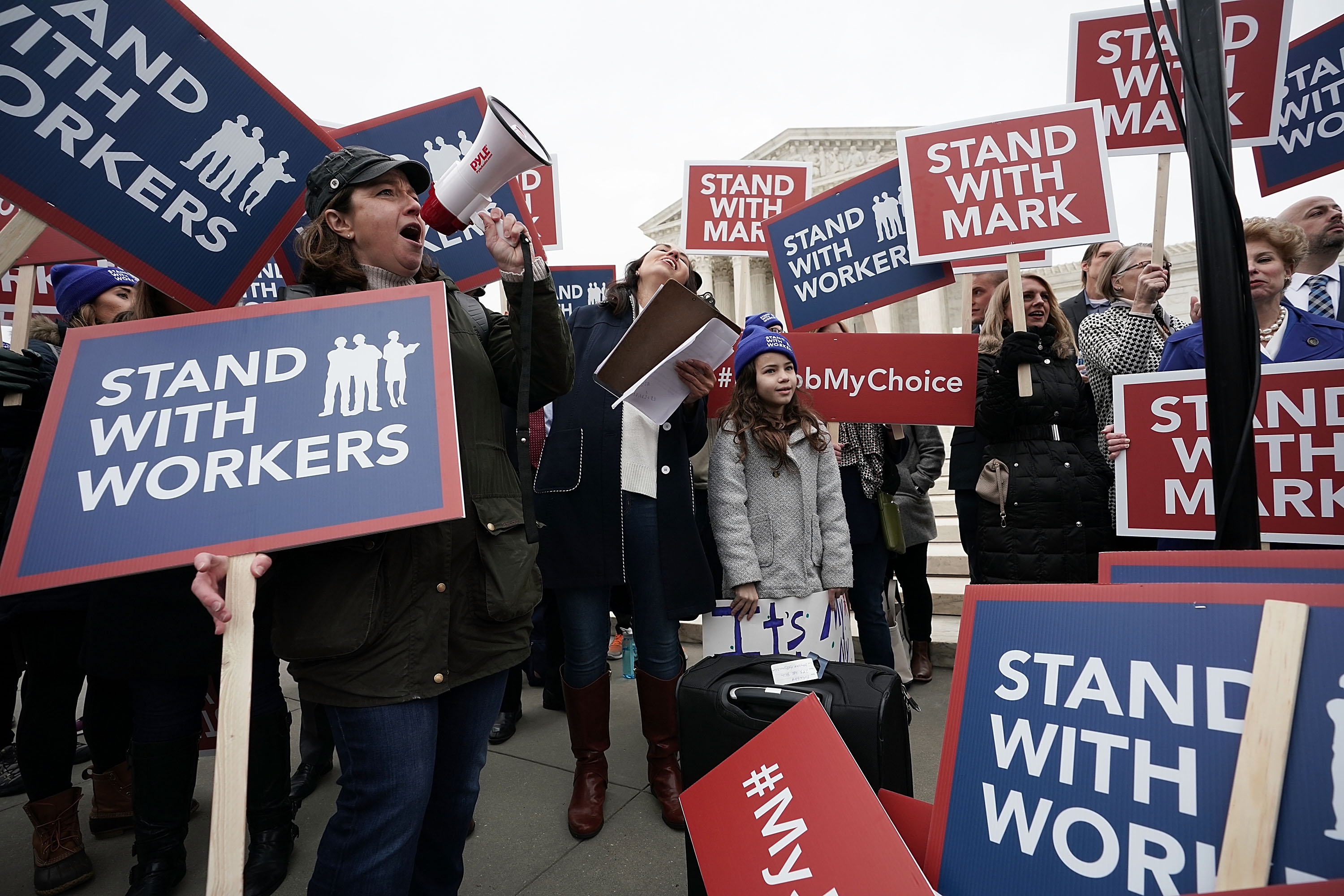
Janus v. AFSCME

(Photo by Alex Wong/Getty Images)
It's been a difficult week of SCOTUS news, though of particular interest to us is the Janus v. AFSCME decision, which finds that public sector unions cannot collect non-member fees (agency fees) even though the collective bargaining of unions affects all workers. It's a move expected to drive down union membership nationwide. (The thinking goes: Why pay membership dues when you get the benefits of union activities anyways?) Some research complicates this basic assumption, but any way we look at it, the next few years will be a struggle. NPR goes into greater depth about expected nation-wide effects of this ruling.

Because Texas is a "Right to Work" state (a rhetorical turn of phrase detested by most labor-minded people; the labor caucus of the Conference on College Composition and Communication has suggested "Right to get Screwed" as a more apt descriptor), this decision will have little direct impact on our specific union. We have no rights to bargain collectively and the union has never collected agency fees.

The fact that we won't feel a direct effect doesn't mean that this won't affect us, though, as our colleagues in other states struggle to keep their membership up. Nationwide, unions are expected to have less funding and less power to stand up to movements that seek to chip away at public education -- from fighting for better funding to opposing privatization and vouchers.

Texas AFT president Louis Malfaro reminds us that now is a moment to win over the "court of public opinion" with reminders about the good that unions do for all workers. We've seen the way that unions of public teachers have won in the court of public opinion, and the effectiveness of their moves for collective action, especially in states like Texas where collective bargaining was never an option.


Steps for Action Now:

1. Follow the AFT on Facebook and/or Tweet and express your support for unions using hashtags #IamAFT, #JanusvsAFSCME #unionstrong, as well as handles: @AFTunion and @TexasAFT. See the AFT's tweet here for graphics you can use.

2. Support, campaign for, and then vote for people who support unions.

3. Sign the AFT's petition (if you haven't already) in support of public education.

Thursday, May 31, 2018

SCOTUS 5-4 Decision Strikes Blow to Worker Rights


The Supreme Court delivered a decision last week that immediately and negatively affects all workers: for the first time, employers can require that workers may not band together to challenge violations of federal labor laws.

Some background:

  1. The 1925 Federal Arbitration Act allows employers to bar collective legal actions by employees, substituting private arbitration. 
  2. The 1935 National Labor Relations Act (NLRA) protects the rights of workers to band together to challenge allegedly illegal actions by their employer.
  3. The current lawsuit was brought by employees against Ernst & Young LLP (Houston), Epic Systems Corporation (Verona WI), and Murphy Oil USA (El Dorado AR). Those corporations have hiring requirements that employees may not act as "class." Of course, individual employees may sue their employers. 
Image result for scotus
Source: Creative Commons

A Century after the NLRA

By the right swing of the SCOTUS, the conservative majority has become increasing hostile to class actions and favoring individual arbitration. The right to create a class is an essential core for solidarity laborers: the right to band together to file class action lawsuits either in federal court or at minimum, to arbitrate such claims as a group. Over decades, the suits of classes include claims from disputes over wages to disputes of alleged discrimination based on race, gender, religion, or national origin. Without class negotiation for employee rights, the employer has enormous power at recruiting, hiring, creating in-working environments, and terminating.

Up to 2014, quoting Moshe Marvit in In These Times:
On April 2, 2014, Jacob Lewis, who was a technical writer for Epic Systems, received an email from his employer with a document titled “Mutual Arbitration Agreement Regarding Wages and Hours.” The document stated that the employee and the employer waive their rights to go to court and instead agreed to take all wage and hour claims to arbitration. Furthermore, unlike in court, the employee agreed that any arbitration would be one-on-one. This “agreement” did not provide any opportunity to negotiate, and it had no place to sign or refuse to sign. Instead, it stated, “I understand that if I continue to work at Epic, I will be deemed to have accepted this Agreement.” The workers had two choices: immediately quit or accept the agreement. This is not the hallmark of an agreement; it is the hallmark of a mandatory rule that is unilaterally imposed.
In the 2017 SCOTUS argument, Justice Ruth Bader Ginsburg criticized any employer's "waiver" against class action rights have all the essential features of the classic "yellow dog contract." That is, there is no real "liberty of contract" for employees. Instead, the employer says, "You want to work here, you sign this." And that, added Ginsburg, is exactly the kind of "imbalance" in negotiating power that the National Labor Relations Act was intended to correct by protecting the ability of employees to act collectively.

The corporations' lawyers expect small and large businesses to immediately move to impose these binding arbitration contracts to eliminate the fear of costly class-action verdicts from juries. "It gives employers the green light to eliminate their single largest employment law risk with the stroke of a pen," he said Ron Chapman, who represents management in labor-management disputes.

Responses

Today, five justices on the Supreme Court decided that it is acceptable for working people to have our legal rights taken away by corporations in order to keep our jobs. This decision forcing workers to sign away the right to file class-action suits against such illegal employment practices as wage theft, sexual harassment and discrimination is outrageous—and it is wrong. In this case, the newest justice has joined the dangerous trend of this court to side with corporations over working people. We call upon Congress to immediately enact legislation making clear that no worker can be forced to give up their right to effectively challenge illegal conduct in the workplace in order to keep their job.

Additional Reading

Christian Faras at the New York Magazine in his article "The Supreme Court Has Decided to Shut Workers Out of the Courthouse for Good" has a good summary and implications of this decision for millions of workers:
The ruling is a devastating blow to employees who are required to sign arbitration agreements as a condition of employment — according to one report, more than 60 million workers operate under such an arrangement, which effectively forces them to resolve their disputes with their employers in a quasi-judicial hearing rather than in a court of law. Of those, about 25 million are subject to a class-action bar.
Terri Gerstein and Sharon Block at the New York Times's piece, "Supreme Court Deals a Blow to Workers" argue that this is one of the strongest threats to employees:
The Supreme Court has just told the nation’s workers: If you’re underpaid at work, or if you face discrimination on the job, you’re on your own.
Many are also concerned about the effect of this decision on lawsuits related to #MeToo and addressing systemic sexual and gender-based harassment in the workplace. The recent movement -- even in name -- is a reminder of the importance of workers coming together, demonstrating the vital importance of spaces for employees to share similar stories and address them not in individual private arbitration, but in large-scale ways that dig into problems of culture and not individuals. (See our previous article on this topic and the importance of addressing sexual harassment as a large-scale issue of culture rather than a problem between individuals.) In the In These Times piece, "The Supreme Court’s Latest Anti-Worker Decision Deals a Major Blow to the #MeToo Movement," Palak Shah, social innovations director for the National Domestic Workers Alliance, notes:
#MeToo has shown us that the abuse of power is not one ‘rotten apple in a barrel’: It is widespread and systemic, especially in low-wage industries. ... We need checks on power—like collective action—to counter abuses of power when they happen. While unchecked power imbalances exist between employers and workers, we can be sure abuses like sexual harassment will continue.

Saturday, May 19, 2018

Rally for Public Education, today 12-3pm


Join public educators and allies today at Discovery Green from 12-3 to show your support for public education. You can also use the hashtag #txspeakout and check out the Facebook page here.

The goals of today's rally, as articulated by the AFT, are:

1) To show solidarity in our pledge to vote for public education supporters in the primary runoffs and November general election.

2) To show legislators, the governor and the lieutenant governor that we won't take "no" for an answer to these demands:
  • An increase in the state contribution to public education funding, including a significant increase in state per-pupil funding.
  • A state-funded pay raise for all school employees.
  • An increase in the contribution of state funds for health care for retired and active public school employees, and an increase in the state contribution rate for school employee pensions.
  • Fix the punitive accountability system by eliminating A-F ratings and repealing the law that lets the Texas Education Agency take over school districts.
Whether or not you can attend, head over to sign the petition in order to express your support of these goals. We stand in solidarity with public educators across Texas who are standing up for students and themselves.

Wednesday, May 16, 2018

North Carolina Teachers Protest

Photo: Gerry Broome/AP/REX/Shutterstock

Thousands of North Carolina teachers marched in Raleigh today, joining other red state teacher groups to demand better pay and public school funding. Like teachers in other states, North Carolina sees themselves faced with falling or stagnant investment in public education while private businesses see tax cuts.


In announcing the march and day of advocacy, The North Carolina Association of Educators noted that North Carolina "is one of the worst in the country in the amount our elected leaders spend per student, about $2,400 behind the national average," in addition to ranking 37th in teacher pay. Many teachers, today in NC and in other states, have highlighted the fact that they are not marching solely for improvements in personal salaries, but for changes to the way public education is funded. It's an important reminder that the conditions of labor for teachers are a direct reflection of the state's support of public education.

The goals of the march were to demand from leaders in the state general assembly:
  • Significant investment in per-pupil spending so our students have the resources to be successful.
  • A multi-year professional pay plan for educators, education support professionals, administrators and all other school personnel. This plan must include restoration of compensation for advanced degree and longevity. The plan must also stop the flat-lining of experienced educator’s pay.
  • Investing in the health and well-being of our students and making schools safer through increased school nurses, counselors, social workers and other support personnel and expansion of Medicaid to improve the health of our communities.
  • Fix our crumbling schools and large class sizes with a Statewide School Construction Bond.
  • Prioritize Classrooms and Not Corporate Board Rooms. (NCAE)

We support these and all other educators fighting for better pay and support, and we encourage all union members to attend the Houston Celebration of Public Education on May 19 to express your support for public education.

Thursday, May 10, 2018

Link: UC Workers on Strike

Workers on strike at a University of California campus, May 7, 2018. 
Photo Credit Meagan Day

Megan Day at Jacobin delves into how the UC Strike is a fight against privatization of the university and the education system:

One of the main battles AFSCME workers face is the constant threat of seeing their jobs outsourced to nonunion workers employed by for-profit companies. As the university increasingly privatizes aspects of its operations, workers employed by the institution are always looking over their shoulder, fearful that their jobs will evaporate overnight and they’ll be replaced by workers who answer to a different boss. “Every day we’re paying attention to when we see new faces on board,” said [UC Berkeley custodian Maricruz] Manzanares. “Suddenly we see a new group of workers and we don’t even know who they are, until we talk to each other and the union and we find out they belong to a company. Lately the university has developed shady techniques. They used to do it openly, but now they’re finding ways to do it in the dark.” Either way, she said, “the university does not behave as a public institution.”
The three day strike ended Wednesday, but UC's response and the question of further action are up in the air.

Read more...

Monday, May 7, 2018

UC System Workers Prepare to Strike


American Federation of State, County and Municipal Employees Local 3299, the largest union in the University of California system, plans to begin a three day strike this week. AFSCME is the largest workers' union in California, and the UC system is the largest state employer, so the ongoing negotiations and the coming strike are important and have huge potential to affect all of California's workers.

AFSCME represents largely lower-income workers, including gardeners, cooks, drivers, custodians, lab techs, and nurse's aids, and these employees are disproportionately women, people of color, and immigrants. An expected 25,000 AFSCME workers will strike, with an equal number expected to join from the California Nurse's Association and the University Professional & Technical Employees union. (UC has requested, and obtained, a restraining order that bars "essential employees," including pharmacists and respiratory therapists, from joining picket lines.) The union that represents graduate student workers is not officially on strike because of contract agreements, but many graduate assistants and tutors are also expected to exercise their individual rights to join the strike.

The action is taken in response to a recent study and report written by the AFSCME Local 3299 which showed a widening income gap between the highest and lowest wage earners in the system, including the particularly damning statistic that the "share of total payroll cost for UC’s top 10% of wage earners grew from 22% to 31%, while the share for the bottom 50% dropped from 24% to just 22%." The study also found that "UC's highest-paid administrators include a higher proportion of whites and men than the State of California while its lowest-paid workers are mainly people of color and women."

The scale of income disparity, especially as that disparity is so obviously skewed along racial and gender demographics, is unconscionable and particularly egregious in the UC system, though it should be noted that such disparity is not abnormal within academic institutions.

AFSCME's requests in bargaining with the UC management were for wage increases, benefits protections, job security, and ending this discrimination. The raises that have been offered, paired with other cuts within the system, have been deemed unacceptable, and the union voted to strike back in April.

In addition to the large nature of the union action, this strike is also important because it represents solidarity from higher paid workers, such as those represented by the CNA, with the lower-wage workers of AFSCME. Workers with higher salaries and better protections within the institutions are joining the fight, an absolute necessity for true change. 

We stand in solidarity with workers in the UC System as they fight for equality and fairness in the workplace.

Monday, April 30, 2018

Updates on Arizona Educators' Calls for Pay Increase


As of Monday 30 April, Arizona educators have completed two (2) days striking, closing schools, and marching across the state. Arizona's teachers have been building on the increasing resistance to red states from educators, and they continue the solidarity movement. (Colorado teachers are also threatening to strike) As recently as Tuesday 17 April, Governor Doug Ducey said he would not meet with organizers of Arizona Educators United and called their protests a "political circus" coordinated by "political operatives." But last week, the governor offered a budget agreement to boost teacher pay by 20 percent by 2020, though he has not addressed infrastructure improvements. 

On the first strike day, students and educators at more than 1,100 schools participated in walk-ins in support of the teacher effort. #RedForEd organizers estimate more than 100,000 people participated. Today, Monday, marching teachers will attempt to meet with their legislators in the capitol face to face.

The AZ teachers have simple demands:
  • 20% raise for all teaching and certified staff
  • Competitive wages for all classified staff
  • Return school funding to 2008 levels (23:1 class ratio)
  • No new corporate tax cuts until AZ per-pupil spending reaches national average
  • Yearly raises until AZ teacher salary reaches the national average
Arizona teachers are among the lowest paid in the country, according to federal data. Average salaries last year were actually $8,000-$9,000 less than 1990 salaries when adjusted for inflation.

We should notice that teachers' solidarity actions -- specifically, a single day walk-out -- was effective. Communities supported the teachers after very effective communication and planning. Notice the effective video by Arizona Educators United:


We recommend following Arizona Educators United for both information and their strategies to communicate with their teachers, their communities, and their legislators.

In this blog, we are very interested in West Virginia, Kentucky, Oklahoma, and, now, Arizona educators using effective strategies to press their claims. We hope that Texas educators can learn from these movements to change our state education environment.

Thursday, April 19, 2018

Hungry Students, the Union, and the College's Responsibilities


A recent article in the Texas Tribune showed nicely how the increasing cost of Texas state college tuition is affecting working-class students. For example:
A student today would have to work 62 hours a week at a minimum wage job to cover the full cost of attending a public four-year college, according to research from Trellis, a nonprofit that tracks student debt issues.
We should not be surprised with these numbers nor are we surprised that the State of Texas government continues to ignore the relationships of poverty in Texas, access to higher education, and health in our communities' families (for more data on poverty in Texas, see here). All student costs are increasing, while local household incomes are stagnant. Here, we focus on food costs for student college students:
Source: Trellis Company
The U.S. Department of Agriculture (USDA) estimates the minimum dietary needs of an adult can be met on $267 per month provided that all food is prepared at home, an unlikely scenario for young adults. Many of our Lone Star College students, however, do not have sufficient employment for even $267 per month and many of those students actually bring their income back to their families collectively (this is another blog post, forthcoming). Many students live in areas where they cannot find jobs; other jobs struggle with transportation, course demands, jobs, and family responsibilities. In short, our students are hungry. That hunger is both a distraction, but cognitively affecting academic performance.

  • 36 percent of university students were housing-insecure in the past year, as were 46 percent of community college students.
  • Less than half of all students surveyed reported being completely secure, meaning they did not experience any food or housing insecurity, or homelessness, in the past year.
  • Black and Native American students were more likely than non-Hispanic white or Asian students to experience food or housing insecurity.

We applaud our faculty colleagues who bring food to their offices, to the classrooms, to writing centers and other places for students to grab an apple or snack bar. Students are amazingly grateful for these gifts from faculty pockets. But colleges must realize that these students' hunger immediately and directly affect the college's success.

Houston Community College aggressively addresses hunger and we recommend the Tribune's summary and Houston Chronicle's recent attention to this too-silent discussion. We also applaud LSC-Montgomery's years of food pantry experience and LSC-North Harris's student emergency fund and emerging food pantry program. BakerRipley, partnering with East Aldine Management District and local churches, are aware of these food insecurity concerns.

But the college must be much more aware and assertive in addressing this long-term and persistent community problem.

We propose this in three prongs:

  1. Each college should make their campus as centers for research of food in the communities, including food deserts, poverty, and student family access to nutritious food. 
  2. Each campus should connect with current community resources for food banks.
  3. Use the college's political influence to address these concerns at the legislative level, including decreasing tuition and fees. 
Readers, union members, and allies should address this with their union representatives and their Professional and Support Staff Associations and Faculty Senates. Academic departments should address this concern as part of their curriculums [sic] as community problems worthy of intellectual inquery. 

Additional Resources

Trellis Company. "State of Student Aid and  Higher Education in Texas." 2017. https://www.trelliscompany.org/wp-content/uploads/2017/02/SOSA.pdf  
U.S. Department of Agriculture. "Official USDA Food Plans: Cost of Food at Home at Four Levels, U.S. Average, June 2016." (http://www.cnpp.usda.gov/USDAFoodCost-Home.htm);