Showing posts with label strike. Show all posts

Thursday, May 10, 2018

Link: UC Workers on Strike

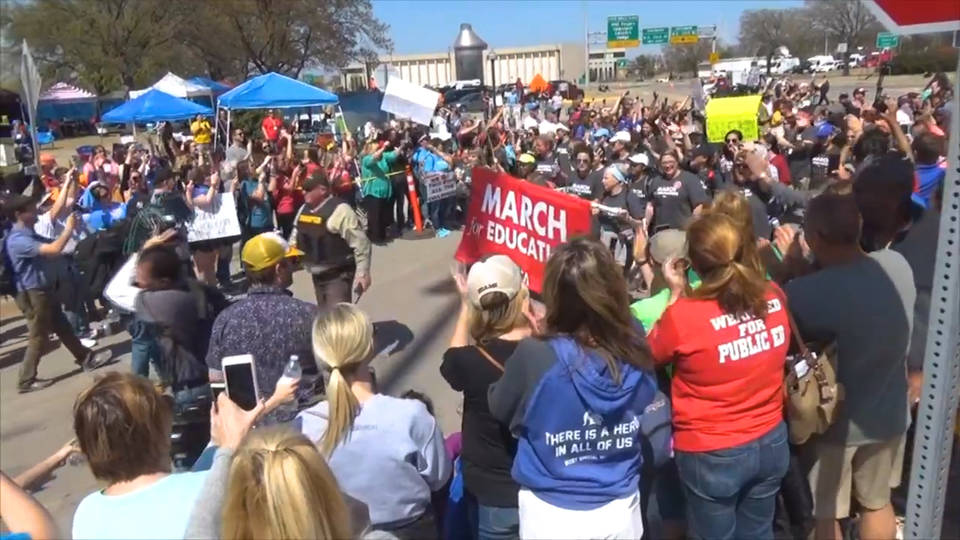
Workers on strike at a University of California campus, May 7, 2018. 
Photo Credit Meagan Day

Megan Day at Jacobin delves into how the UC Strike is a fight against privatization of the university and the education system:

One of the main battles AFSCME workers face is the constant threat of seeing their jobs outsourced to nonunion workers employed by for-profit companies. As the university increasingly privatizes aspects of its operations, workers employed by the institution are always looking over their shoulder, fearful that their jobs will evaporate overnight and they’ll be replaced by workers who answer to a different boss. “Every day we’re paying attention to when we see new faces on board,” said [UC Berkeley custodian Maricruz] Manzanares. “Suddenly we see a new group of workers and we don’t even know who they are, until we talk to each other and the union and we find out they belong to a company. Lately the university has developed shady techniques. They used to do it openly, but now they’re finding ways to do it in the dark.” Either way, she said, “the university does not behave as a public institution.”
The three day strike ended Wednesday, but UC's response and the question of further action are up in the air.

Read more...

Monday, May 7, 2018

UC System Workers Prepare to Strike


American Federation of State, County and Municipal Employees Local 3299, the largest union in the University of California system, plans to begin a three day strike this week. AFSCME is the largest workers' union in California, and the UC system is the largest state employer, so the ongoing negotiations and the coming strike are important and have huge potential to affect all of California's workers.

AFSCME represents largely lower-income workers, including gardeners, cooks, drivers, custodians, lab techs, and nurse's aids, and these employees are disproportionately women, people of color, and immigrants. An expected 25,000 AFSCME workers will strike, with an equal number expected to join from the California Nurse's Association and the University Professional & Technical Employees union. (UC has requested, and obtained, a restraining order that bars "essential employees," including pharmacists and respiratory therapists, from joining picket lines.) The union that represents graduate student workers is not officially on strike because of contract agreements, but many graduate assistants and tutors are also expected to exercise their individual rights to join the strike.

The action is taken in response to a recent study and report written by the AFSCME Local 3299 which showed a widening income gap between the highest and lowest wage earners in the system, including the particularly damning statistic that the "share of total payroll cost for UC’s top 10% of wage earners grew from 22% to 31%, while the share for the bottom 50% dropped from 24% to just 22%." The study also found that "UC's highest-paid administrators include a higher proportion of whites and men than the State of California while its lowest-paid workers are mainly people of color and women."

The scale of income disparity, especially as that disparity is so obviously skewed along racial and gender demographics, is unconscionable and particularly egregious in the UC system, though it should be noted that such disparity is not abnormal within academic institutions.

AFSCME's requests in bargaining with the UC management were for wage increases, benefits protections, job security, and ending this discrimination. The raises that have been offered, paired with other cuts within the system, have been deemed unacceptable, and the union voted to strike back in April.

In addition to the large nature of the union action, this strike is also important because it represents solidarity from higher paid workers, such as those represented by the CNA, with the lower-wage workers of AFSCME. Workers with higher salaries and better protections within the institutions are joining the fight, an absolute necessity for true change. 

We stand in solidarity with workers in the UC System as they fight for equality and fairness in the workplace.

Monday, April 30, 2018

Updates on Arizona Educators' Calls for Pay Increase


As of Monday 30 April, Arizona educators have completed two (2) days striking, closing schools, and marching across the state. Arizona's teachers have been building on the increasing resistance to red states from educators, and they continue the solidarity movement. (Colorado teachers are also threatening to strike) As recently as Tuesday 17 April, Governor Doug Ducey said he would not meet with organizers of Arizona Educators United and called their protests a "political circus" coordinated by "political operatives." But last week, the governor offered a budget agreement to boost teacher pay by 20 percent by 2020, though he has not addressed infrastructure improvements. 

On the first strike day, students and educators at more than 1,100 schools participated in walk-ins in support of the teacher effort. #RedForEd organizers estimate more than 100,000 people participated. Today, Monday, marching teachers will attempt to meet with their legislators in the capitol face to face.

The AZ teachers have simple demands:
  • 20% raise for all teaching and certified staff
  • Competitive wages for all classified staff
  • Return school funding to 2008 levels (23:1 class ratio)
  • No new corporate tax cuts until AZ per-pupil spending reaches national average
  • Yearly raises until AZ teacher salary reaches the national average
Arizona teachers are among the lowest paid in the country, according to federal data. Average salaries last year were actually $8,000-$9,000 less than 1990 salaries when adjusted for inflation.

We should notice that teachers' solidarity actions -- specifically, a single day walk-out -- was effective. Communities supported the teachers after very effective communication and planning. Notice the effective video by Arizona Educators United:


We recommend following Arizona Educators United for both information and their strategies to communicate with their teachers, their communities, and their legislators.

In this blog, we are very interested in West Virginia, Kentucky, Oklahoma, and, now, Arizona educators using effective strategies to press their claims. We hope that Texas educators can learn from these movements to change our state education environment.

Thursday, April 12, 2018

Update on OK Resistance -- a 100 Mile Walking Trek to the Capitol


Resistance has multiple faces. Resistance is writing letters and cards to our representatives. Resistance is walking out of the classroom to fight for protecting students. Resistance is wearing a red shirt in solidarity with educators across the nation.

And sometimes, resistance is walking. But not just across the parking lot. We’re talking a lot of walking -- 100 miles of walking.

Our colleagues in Oklahoma started a 100-mile long trek from multiple towns and cities to the OK Capitol to demonstrate their commitment calls for an equitable pay and school budget support (see our previous post here).

"We do appreciate the raise. The main reasons that teachers are walking are because of the lack of funding for classrooms, the things that affect kids," said Brendan Jarvis, a seventh-grade geography teacher in Tulsa. "We're marching for the kids, for better school supplies, so teachers don't have to buy all of them out of pocket."
H8 oklahoma teacher march strike continues
Image Credit: YOUTUBE: "OK TEACHERS SPEAK"

Though the OK government did offer a pay raise, the legislature had removed school budget support.
Oklahoma-AFT President Mary Best and Oklahoma City President Ed Allen issued the following statement:
“We are disappointed but not surprised that Gov. Fallin repealed the hotel/motel-tax that would have yielded additional funding for public schools. Over the last two weeks in this fight for Oklahoma’s teachers, we’ve made clear that pitting teachers against kids is a losing strategy. We will keep fighting to make sure there’s funding for both, because it’s what our teachers need, and what our kids deserve. 
“In the meantime, we encourage the state Legislature to consider quickly the wind production and capital gains tax bills as potential revenue streams: Oklahoma needs an increase in public education funding on top of teacher raises. And we need it soon, so we can get back to the classroom. 
“Make no mistake: Our teachers want to be in school—teaching. But they’ll remain in the capital until these legislators make good on their duty to fund our state’s schools.”
Thursday, thousands of educators arrived at Tulsa where they intend to meet with legislators.

This blog will follow our colleagues' success.

Teachers in other states are striking. Texas teachers can't do that.

Source: Texas Tribune


Texas statute says any employees who "strike or engage in an organized work stoppage against the state or a political subdivision of the state" will lose all their "civil service rights, reemployment rights, and any other rights, benefits, and privileges the employee enjoys as a result of public employment or former public employment."

That’s us -- we’re state employees and community colleges are “political subdivisions of the state.” This, while the State of Texas is persistently decreasing funding of community colleges while increasing regulation and control over curriculum.

Read more from the Texas Tribune.

Thursday, April 5, 2018

Teachers Strikes Expand -- Updates on Kentucky and Oklahoma … and Arizona!

Source: David Wallace, Arizona Republic


Increasingly, educators in red states are exercising their constitutional rights to protest their low salaries, attacks on retirement funds, and working situations. We mentioned the wildcat walkout last week. Now, Oklahoma teachers are preparing for a strike as they reject the governor’s pay increase.


The resistance against GOP governors and legislature is also expanding in Arizona. Grassroot group Arizona Educators United and the union affiliate, the Arizona Education Association, call for a 20% pay raise, while Governor Ducey adamantly rejects this proposal, with a mere 1% increase.


The Texas AFT stands in solidarity with our colleagues in Oklahoma:
At its core, this is about teachers’ and school support workers’ heartbreaking teaching and learning conditions. Funding public education adequately is a fight that we must win because it’s the right thing for our kids, for our economy and for America.

For a summary of the KY and OK strikes, read this Mercury News article and for more information on the Arizona labor initiative, see a brief summary by NPR Illinois. We also recommend appreciating the strength of women in these strikes, here at USA Today.

Saturday, March 31, 2018

Kentucky Teachers Call Wildcat Walkout In Resistance to Legislative Pension Scuttle


Source: Sarah Coomes Crisp, Twitter

Over the past 10 years, Republican-controlled legislatures across the country have slashed corporate taxes, decimated school funding, ignored teachers’ pleas for raises, and tried their best to crush public employees’ collective bargaining power through unions. Now, the teachers are fighting back. After West Virginia teachers went on strike, similar actions have been sweeping red states, from Oklahoma, to Arizona, and now, to Kentucky.

Last week, the Republican legislature majority unveiled a new 291-page pension bill, zipped it through both the House and Senate, and sent it to the governor's desk -- all in less than nine hours.

In response, many Kentucky schools closed on Friday as teachers walked out, according to the Courier Journal. The Kentucky Education Association, which represents teachers and other education professionals, slammed the pension law as a "classic legislative bait and switch."
It stripped all the 'local provision of wastewater services' language out of SB151 and replaced it with many of the harmful provisions of SB1. ... We haven't seen the bill, weren't allowed to testify. The bill hasn't had the required actuarial analysis, includes no fiscal impact statement and no fiscal note.
For more information, read “Teacher walkouts over pay and pensions have spread to Kentucky” at Vice.com

Saturday, March 24, 2018

Labor News (UPDATE): Black Hawk College Union Members Overwhelmingly Approve Vote to Strike

UPDATE: 
The Black Hawk College strike was averted after an agreement was reached between the Union and the board. Educators will have improved pay, health care, and fairer overtime loads.

Source: Nick Youngson CC BY-SA 3.0 Alpha Stock Images


Black Hawk College is a community college in Illinois with campuses in the cities of Moline and Galva. AFT colleagues in the Illinois Federation of Teachers (Local 1836) voted on 9 March 2018 to strike as negotiations between the union and administration have stalled. The union has not had a contract since the summer 2017. On March 9, it filed an intent-to-strike notice with BHC, paving the way for the union to strike after a 10-day waiting period that expired Monday.


Union member Professor Galen Leonhardy argues:
Whether our board members force us to strike or recognize the vulgarity of their recent rationalizations, I refuse to take yet another pay reduction, refuse to pay even more for health care, and refuse to support a board that wants to decrease by thousands and thousands of dollars, junior faculty members’ retirements.  
I refuse to have faith in and support a board that has spent millions adding buildings on campus while enrollments fell, new buildings, one of which remains essentially hollow, a place of learning without learners.  
I am done with authoritarian board members hiring and subsequently empowering authoritarian administrators who have fixated on chilling academic freedom while failing to fulfill their own basic responsibilities.
Our union leaders are doing a super job of helping members hold onto our health care, achieve a basic cost of living increase, prevent the board members from diminishing junior faculty members’ retirements, and keep the board members from cutting the salaries of our senior faculty members.  
Our union leaders have negotiated for more than a year with board members, with elected officials who have very limited backgrounds in education, folks who were willing to pay a lawyer astronomical amounts (over $100,000) just to prevent faculty and professional/technical employees from having even a cost of living raise.  Yet those same board members have given raises to our administrators (who appear to pay for their raises by laying off faculty members).
Thanks to the union, we have a wonderful health care and insurance plan. Had we trusted that our administrators would take care of us, we would never have had the quality of health care we currently enjoy.   If I get sick or have an accident, I will be taken care of.  I have a child who needed hospitalization, and the insurance covered almost all of the expenses.  Our family members get to attend the first two years of college for almost nothing.  I have a fair wage and a great retirement plan. And I have To thank the union for all of those things that help me to feel glad that I have the job I have.
Obviously, I am proud to be a union member, grateful to those past faculty members who put their jobs on the line to create the union, and honored to continue that legacy for future faculty members.
For an update on the negotiations:
http://qconline.com/news/bhc-union-exchange-contract-proposals/article_26cb88a9-5b50-5490-b135-b427fe0aac31.html


Thursday, March 8, 2018

Labor News: West Virginia Educators on Strike -- Update


On Tuesday, West Virginia officials agreed to a budget deal, ending the teacher strike by raising pay for all state workers by 5 percent. The deal follows more than a week of protests across the Appalachian state supported by the AFT.

More than 277,000 students were out of the classroom for nine school days as teachers pressed for higher salaries in West Virginia, where pay ranks near the bottom for U.S. teachers. 

The West Virginia Education Association hailed the deal, saying on its Facebook page: “WE WON!”

The win for teachers is especially notable given their political situation. While West Virginia has no laws explicitly making such a strike illegal, public employees such as teachers do not have a legal right to strike against their state or to collectively bargain. Teachers participating in the strike risked disciplinary action in mounting a work-stoppage, but they still worked together to make themselves heard, rally public support, and improve pay for all state workers. 

To remind us that these educators’ lives are among the poorest labor environment (the 48th lowest salary in the nation), we recommending the interview with teacher Katie Endicott, a high school English teacher, with the New York Times

We also recommend another interview with Jacobin’s Eric Blanc, who sat down with Jay O’Neal, a middle-school teacher and union activist in Charleston. O’Neal explains his organizing strategies, parents’ attitudes (positive), and union member dynamicism.

In the wake of the success of these teachers, it appears teachers in Oklahoma  one of only two states with lower pay than West Virginia before their action  may be following.

Tuesday, February 27, 2018

Labor News: West Virginia Educators on Strike


West Virginia's teacher salaries are among the lowest in the nation. According to the West Virginia Education Association, a new teacher with only a bachelor's degree will have a minimum starting salary of about $32,700. Teachers have called upon the state legislature to fund both pay raises and the public employee's health care program.

[Credit AFT-WV PRESIDENT CHRISTINE CAMPBELL]


The 2018-19 benefits plan for public employees would have increased health care premiums on some insurees, mostly due to a provision using total family income to set premiums for family and employee and spouse coverage, according to the Charleston Gazette-Mail. Local teachers also point to West Virginia's falling population and the strong pull for young teachers to move elsewhere, where pay and health subsidies are better. Without changes, they see a future with even fewer educators left in the state.


West Virginia teachers acted to strike on Thursday 22 February 2018 with the strike entering its fourth day on Tuesday 27 February. To be clear, the WV Attorney General Patrick Morrisy claims that teacher strikes and "concerted work stoppages" are illegal in WV, but local AFT leader Christine Campbell explains that "The crisis in public education in this state has come to a head, and teachers and service personnel have reached their breaking point." AFT President Randi Weingarten visited with teachers and walked with the march, in solidarity.

Read more: West Virginia Teachers Launch Statewide Strike