Showing posts with label SCOTUS. Show all posts

Sunday, July 22, 2018

Responding to Janus, Part II

Last month, we wrote a brief summary of the SCOTUS decision of Janus v AFSCME. Since the decision, we have more time to reflect on how this right-wing court affects us as workers and as union members. With our reflections, we call for more assertive actions, especially locally, to strengthen our union in Texas.

1. The Court framed its decision as a First Amendment cause. The Court is wrong. We can address this as Texans.

The Court effectively overturned an important 1977 court decision (Abood v. Detroit Board of Education if you want to learn about that background) and argued that the First Amendment's protection of free speech prohibits public employee unions from charging a mandatory fee for the costs of representation. In Texas, we don't feel the effect of mandatory union fees for representing, but in otherwise union-friendly states, the effect of union collective bargaining is somewhat mixed in some facets and clear in others. According to The Brookings Institute (a conservative think tank), "collective bargaining rights lead to substantial increases in union presence and modest increases in wages" while "evidence on the effect of collective bargaining on public employee retirement benefits is much scarcer."

The collective bargaining act was seen as a free speech act, and Janus argued that he should not be forced to use his "speech" (union fees) though he is rewarded by the union's bargaining. However, the Court's minority dissent notes that unions do not inhibit the freedom of speech of members or non-members. While labor unions have a right to equitably represent all workers in a bargaining act, labor unions are, by law, the exclusive representatives of workers. This means that workers cannot have two labor unions representing them within the same working situation (you can imagine what a Detroit factory would look like with two working unions representing the floor, attempting to bargain with Ford; thus, the law permits only one union representing all workers). 

This singular representation is not unique to unions. We do the same in our communities where we all represent ourselves collectively in the voting machine for our taxes (note: this is ideal, of course, and we are not arguing that our voting system is either fair or equitable, especially in Texas. But let's pretend). As a taxing "collective," we cannot declare one day that as a result of differences with a government body that we should be able to avoid taxes. 

But as Bill Fletcher explains:
In the case of labor unions, they have been granted by law the right and duty to represent workers in a given economic jurisdiction—a bargaining unit. Workers in the public sector are not obligated to join the union but the compromise that was established, and been in operation for 41 years in many states that permit public sector unionism, was that those who choose not to join contribute towards representation costs. Thus, an individual worker who decides not to join the union may, nevertheless, face an issue for which they need representation. Representation costs money. A case may go to arbitration, for instance, which can be very expensive. There may be issues that have to be litigated in court. Indeed, an issue may need to go to a legislative body. These steps can be very expensive. The Supreme Court majority knows this and, essentially, what they said today is that they do not give a damn.
As Texans, we can address this easily:

  1. Explain to your colleagues that this was not about free speech. This is about how collective bargaining helps all workers. 
  2. Learn about collective bargaining and have a conversation with your local Texas legislator and senator. Yes, most of our legislative representatives are anti-labor, but our silence only encourages demagogues like Abbot and Patrick .
  3. Look at immediate history. The massive teacher strikes this year in West Virginia, Kentucky, Oklahoma, Arizona, Colorado and North Carolina have all taken place in “right to work” states like Texas, and this common fact was likely no coincidence. Workers in “right to work” states tend to have lower salaries and fewer benefits. Remind your local legislator.

2. Let's See a Perspective of the Impact -- Public Sector Unions

The court's decision certainly continues a national trend towards attacking labor-sector unions, such as in Illinois and Wisconsin, where since 2010, union membership declined 38 percent after the attacks on unions by Gov Walker and the Legislature (for a good resource of current news on labor issues such as happening in Wisconsin, see LaborNotes.org). Yet, the international union movement is larger than public-sector, while our national (and state) hostility toward labor-sector union has been part of our lives for decades. Moshe Marvit summarizes this:
the Janus decision will only directly impact less than half of the labor movement. This is because the ruling only applies to public-sector workers: federal, state and local government employees. However, federal employees (including postal employees) have long been under so-called “right to work,” so Janus will have minimal direct impact on them.
So, as Texans, we can address this:
  1. Be proactively engaged as a union. More than paying dues, be verbal, physical present. Specifically,
  2. Be present for Board of Trustees meetings: start at least once a year and remind the Board that you are a union member
  3. Meet your local legislative representative. Local has power while federal representatives are weak. Write your Texas legislator and senator and remind them how our union protects us as employees and strengthens us as citizens. Let them know that our union is very alive
  4. Inform other college employees about our union's efforts. Recruit other members to be paying union members.

3. On the other Hand, Understand that Some Populations will be Harder than Others ... Read: than Whites. Duh.

As Miles Kampf-Lassin argues, national public-sector unions disproportionately empower Black women, "this class of hyper-exploited workers is poised to be hit hardest by the anti-union ruling."
Source: Economic Policy Institute
While public-sector labor has facilitated Black women moving into the middle class, the ugly truth is that, on average, African-American women have to work seven months longer to receive the same pay as white men. The Janus decision further exacerbates that economic disparity. This discussion of color, unions, and education needs to be discussed elsewhere.

Here, we recommend:
  1. We need to hear more voices of Black women and men, Latinx women and men, and all disenfranchised workers in the college. Their stories often stun us. Our union chapter is open to all, but we see too many white voices and representation, which makes it especially important to listen. 
  2. We very pointedly want to understand real racial equity in the college at every corner: administration, faculty, and staff. For example, we call for a Freedom of Information Act request for hiring status, hiring persistence, and salary at LSCS. Though some tools show salaries for University of Houston and Houston Community College, no open data are available for LSCS.
  3. Trust Black Women.

4. Remember Who Represents Who: Texas Senator Ted Cruz

The Liberty Justice Center, one of the parties that represented Janus in court, received $800,000 from a policy institute funded by Richard Uihlein, an anti-union megadonor, according to tax forms reviewed by OpenSecrets. Uihlein is an Illinois businessman who has spent millions of dollars supporting Republican candidates such as Sen.Ted Cruz (R-Texas).

This is not a surprise, but as Texans, we have a responsibility to 
  1. Inform (repeatedly) Senator Cruz how his poise against workers affects us, and
  2. Connect with other Houstonians resisting Senator Cruz's agenda against people of color, migrants, workers, and everything that AFT stands for.
Postscript: As of 20 July, Mark Janus has left from his public-service position ... to work for the Liberty Justice Center, making even more money.
“Once again it’s clear that this court case was never about Mark Janus, but about billionaires like Bruce Rauner and big-money corporate funders launching a political attack on the freedom of working people to speak up together through a strong union,” AFSCME Council 31 spokesman Anders Lindall said. “While IPI tries to dupe workers into quitting their union, AFSCME members will continue doing what they’ve always done: providing important public services and building their union to speak up for themselves, their families and communities.”

Additional Reading

Compa, L. (2014). "An Overview of Collective Bargaining in the United States." Digital Commons.

Semuels, A. (2018). "Is This the End of Public-Sector Unions in America?" The Atlantic. 

Tang, A. (2018). "Life After Janus." [see whole 81-page PDF]

Saturday, June 30, 2018

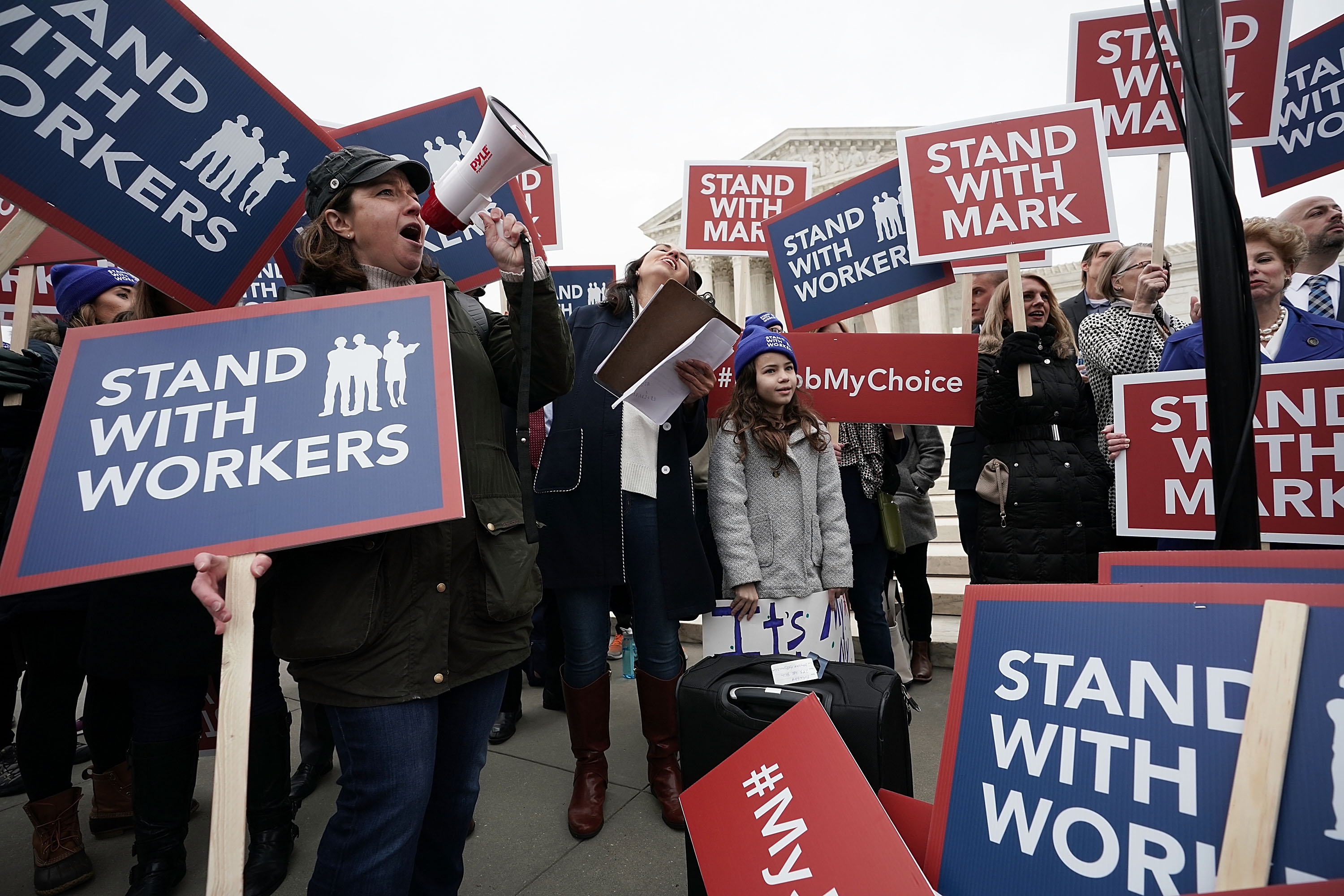
Janus v. AFSCME

(Photo by Alex Wong/Getty Images)
It's been a difficult week of SCOTUS news, though of particular interest to us is the Janus v. AFSCME decision, which finds that public sector unions cannot collect non-member fees (agency fees) even though the collective bargaining of unions affects all workers. It's a move expected to drive down union membership nationwide. (The thinking goes: Why pay membership dues when you get the benefits of union activities anyways?) Some research complicates this basic assumption, but any way we look at it, the next few years will be a struggle. NPR goes into greater depth about expected nation-wide effects of this ruling.

Because Texas is a "Right to Work" state (a rhetorical turn of phrase detested by most labor-minded people; the labor caucus of the Conference on College Composition and Communication has suggested "Right to get Screwed" as a more apt descriptor), this decision will have little direct impact on our specific union. We have no rights to bargain collectively and the union has never collected agency fees.

The fact that we won't feel a direct effect doesn't mean that this won't affect us, though, as our colleagues in other states struggle to keep their membership up. Nationwide, unions are expected to have less funding and less power to stand up to movements that seek to chip away at public education -- from fighting for better funding to opposing privatization and vouchers.

Texas AFT president Louis Malfaro reminds us that now is a moment to win over the "court of public opinion" with reminders about the good that unions do for all workers. We've seen the way that unions of public teachers have won in the court of public opinion, and the effectiveness of their moves for collective action, especially in states like Texas where collective bargaining was never an option.


Steps for Action Now:

1. Follow the AFT on Facebook and/or Tweet and express your support for unions using hashtags #IamAFT, #JanusvsAFSCME #unionstrong, as well as handles: @AFTunion and @TexasAFT. See the AFT's tweet here for graphics you can use.

2. Support, campaign for, and then vote for people who support unions.

3. Sign the AFT's petition (if you haven't already) in support of public education.

Thursday, May 31, 2018

SCOTUS 5-4 Decision Strikes Blow to Worker Rights


The Supreme Court delivered a decision last week that immediately and negatively affects all workers: for the first time, employers can require that workers may not band together to challenge violations of federal labor laws.

Some background:

  1. The 1925 Federal Arbitration Act allows employers to bar collective legal actions by employees, substituting private arbitration. 
  2. The 1935 National Labor Relations Act (NLRA) protects the rights of workers to band together to challenge allegedly illegal actions by their employer.
  3. The current lawsuit was brought by employees against Ernst & Young LLP (Houston), Epic Systems Corporation (Verona WI), and Murphy Oil USA (El Dorado AR). Those corporations have hiring requirements that employees may not act as "class." Of course, individual employees may sue their employers. 
Image result for scotus
Source: Creative Commons

A Century after the NLRA

By the right swing of the SCOTUS, the conservative majority has become increasing hostile to class actions and favoring individual arbitration. The right to create a class is an essential core for solidarity laborers: the right to band together to file class action lawsuits either in federal court or at minimum, to arbitrate such claims as a group. Over decades, the suits of classes include claims from disputes over wages to disputes of alleged discrimination based on race, gender, religion, or national origin. Without class negotiation for employee rights, the employer has enormous power at recruiting, hiring, creating in-working environments, and terminating.

Up to 2014, quoting Moshe Marvit in In These Times:
On April 2, 2014, Jacob Lewis, who was a technical writer for Epic Systems, received an email from his employer with a document titled “Mutual Arbitration Agreement Regarding Wages and Hours.” The document stated that the employee and the employer waive their rights to go to court and instead agreed to take all wage and hour claims to arbitration. Furthermore, unlike in court, the employee agreed that any arbitration would be one-on-one. This “agreement” did not provide any opportunity to negotiate, and it had no place to sign or refuse to sign. Instead, it stated, “I understand that if I continue to work at Epic, I will be deemed to have accepted this Agreement.” The workers had two choices: immediately quit or accept the agreement. This is not the hallmark of an agreement; it is the hallmark of a mandatory rule that is unilaterally imposed.
In the 2017 SCOTUS argument, Justice Ruth Bader Ginsburg criticized any employer's "waiver" against class action rights have all the essential features of the classic "yellow dog contract." That is, there is no real "liberty of contract" for employees. Instead, the employer says, "You want to work here, you sign this." And that, added Ginsburg, is exactly the kind of "imbalance" in negotiating power that the National Labor Relations Act was intended to correct by protecting the ability of employees to act collectively.

The corporations' lawyers expect small and large businesses to immediately move to impose these binding arbitration contracts to eliminate the fear of costly class-action verdicts from juries. "It gives employers the green light to eliminate their single largest employment law risk with the stroke of a pen," he said Ron Chapman, who represents management in labor-management disputes.

Responses

Today, five justices on the Supreme Court decided that it is acceptable for working people to have our legal rights taken away by corporations in order to keep our jobs. This decision forcing workers to sign away the right to file class-action suits against such illegal employment practices as wage theft, sexual harassment and discrimination is outrageous—and it is wrong. In this case, the newest justice has joined the dangerous trend of this court to side with corporations over working people. We call upon Congress to immediately enact legislation making clear that no worker can be forced to give up their right to effectively challenge illegal conduct in the workplace in order to keep their job.

Additional Reading

Christian Faras at the New York Magazine in his article "The Supreme Court Has Decided to Shut Workers Out of the Courthouse for Good" has a good summary and implications of this decision for millions of workers:
The ruling is a devastating blow to employees who are required to sign arbitration agreements as a condition of employment — according to one report, more than 60 million workers operate under such an arrangement, which effectively forces them to resolve their disputes with their employers in a quasi-judicial hearing rather than in a court of law. Of those, about 25 million are subject to a class-action bar.
Terri Gerstein and Sharon Block at the New York Times's piece, "Supreme Court Deals a Blow to Workers" argue that this is one of the strongest threats to employees:
The Supreme Court has just told the nation’s workers: If you’re underpaid at work, or if you face discrimination on the job, you’re on your own.
Many are also concerned about the effect of this decision on lawsuits related to #MeToo and addressing systemic sexual and gender-based harassment in the workplace. The recent movement -- even in name -- is a reminder of the importance of workers coming together, demonstrating the vital importance of spaces for employees to share similar stories and address them not in individual private arbitration, but in large-scale ways that dig into problems of culture and not individuals. (See our previous article on this topic and the importance of addressing sexual harassment as a large-scale issue of culture rather than a problem between individuals.) In the In These Times piece, "The Supreme Court’s Latest Anti-Worker Decision Deals a Major Blow to the #MeToo Movement," Palak Shah, social innovations director for the National Domestic Workers Alliance, notes:
#MeToo has shown us that the abuse of power is not one ‘rotten apple in a barrel’: It is widespread and systemic, especially in low-wage industries. ... We need checks on power—like collective action—to counter abuses of power when they happen. While unchecked power imbalances exist between employers and workers, we can be sure abuses like sexual harassment will continue.