Showing posts with label labor news. Show all posts

Saturday, June 30, 2018

Janus v. AFSCME

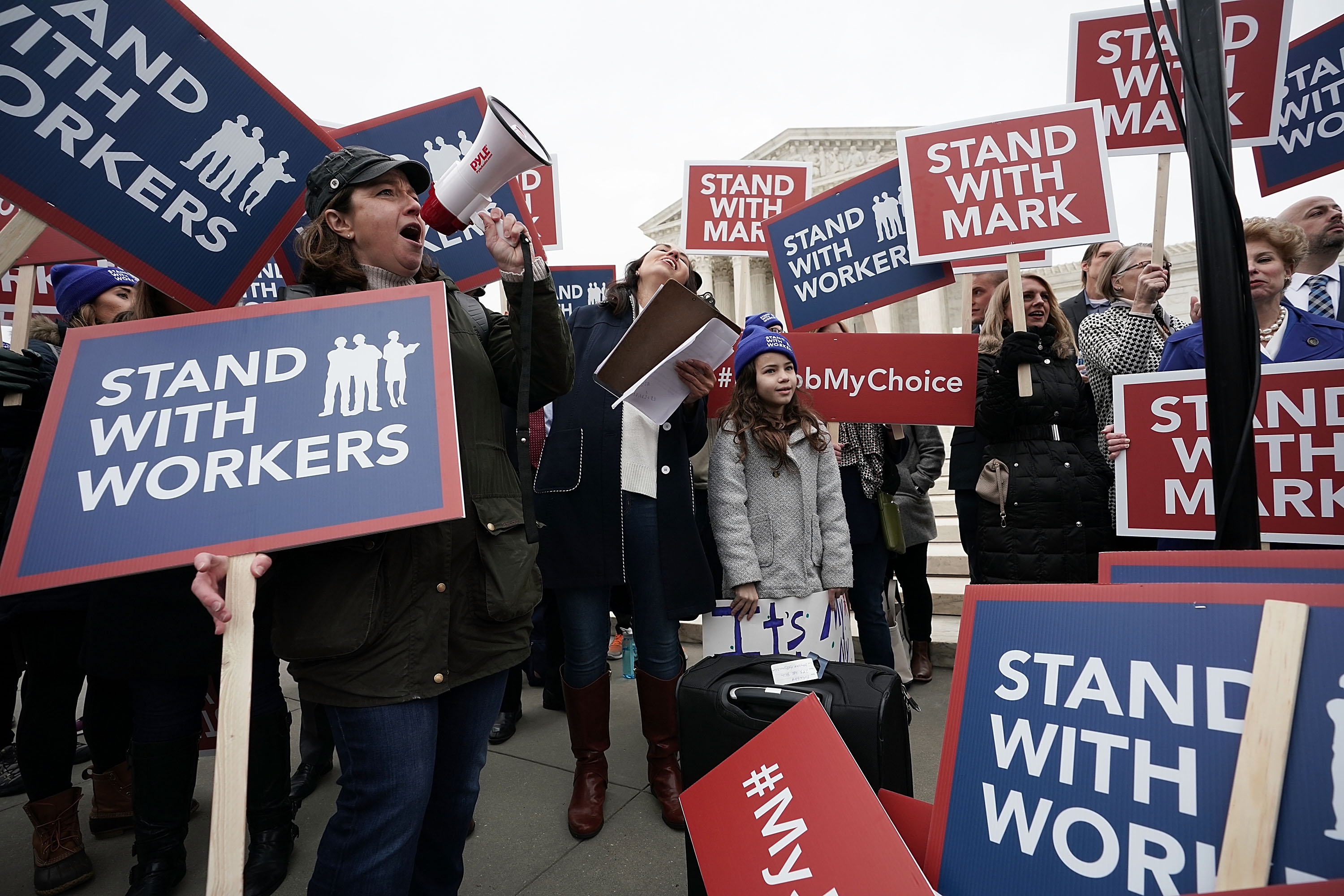
(Photo by Alex Wong/Getty Images)
It's been a difficult week of SCOTUS news, though of particular interest to us is the Janus v. AFSCME decision, which finds that public sector unions cannot collect non-member fees (agency fees) even though the collective bargaining of unions affects all workers. It's a move expected to drive down union membership nationwide. (The thinking goes: Why pay membership dues when you get the benefits of union activities anyways?) Some research complicates this basic assumption, but any way we look at it, the next few years will be a struggle. NPR goes into greater depth about expected nation-wide effects of this ruling.

Because Texas is a "Right to Work" state (a rhetorical turn of phrase detested by most labor-minded people; the labor caucus of the Conference on College Composition and Communication has suggested "Right to get Screwed" as a more apt descriptor), this decision will have little direct impact on our specific union. We have no rights to bargain collectively and the union has never collected agency fees.

The fact that we won't feel a direct effect doesn't mean that this won't affect us, though, as our colleagues in other states struggle to keep their membership up. Nationwide, unions are expected to have less funding and less power to stand up to movements that seek to chip away at public education -- from fighting for better funding to opposing privatization and vouchers.

Texas AFT president Louis Malfaro reminds us that now is a moment to win over the "court of public opinion" with reminders about the good that unions do for all workers. We've seen the way that unions of public teachers have won in the court of public opinion, and the effectiveness of their moves for collective action, especially in states like Texas where collective bargaining was never an option.


Steps for Action Now:

1. Follow the AFT on Facebook and/or Tweet and express your support for unions using hashtags #IamAFT, #JanusvsAFSCME #unionstrong, as well as handles: @AFTunion and @TexasAFT. See the AFT's tweet here for graphics you can use.

2. Support, campaign for, and then vote for people who support unions.

3. Sign the AFT's petition (if you haven't already) in support of public education.

Thursday, May 31, 2018

SCOTUS 5-4 Decision Strikes Blow to Worker Rights


The Supreme Court delivered a decision last week that immediately and negatively affects all workers: for the first time, employers can require that workers may not band together to challenge violations of federal labor laws.

Some background:

  1. The 1925 Federal Arbitration Act allows employers to bar collective legal actions by employees, substituting private arbitration. 
  2. The 1935 National Labor Relations Act (NLRA) protects the rights of workers to band together to challenge allegedly illegal actions by their employer.
  3. The current lawsuit was brought by employees against Ernst & Young LLP (Houston), Epic Systems Corporation (Verona WI), and Murphy Oil USA (El Dorado AR). Those corporations have hiring requirements that employees may not act as "class." Of course, individual employees may sue their employers. 
Image result for scotus
Source: Creative Commons

A Century after the NLRA

By the right swing of the SCOTUS, the conservative majority has become increasing hostile to class actions and favoring individual arbitration. The right to create a class is an essential core for solidarity laborers: the right to band together to file class action lawsuits either in federal court or at minimum, to arbitrate such claims as a group. Over decades, the suits of classes include claims from disputes over wages to disputes of alleged discrimination based on race, gender, religion, or national origin. Without class negotiation for employee rights, the employer has enormous power at recruiting, hiring, creating in-working environments, and terminating.

Up to 2014, quoting Moshe Marvit in In These Times:
On April 2, 2014, Jacob Lewis, who was a technical writer for Epic Systems, received an email from his employer with a document titled “Mutual Arbitration Agreement Regarding Wages and Hours.” The document stated that the employee and the employer waive their rights to go to court and instead agreed to take all wage and hour claims to arbitration. Furthermore, unlike in court, the employee agreed that any arbitration would be one-on-one. This “agreement” did not provide any opportunity to negotiate, and it had no place to sign or refuse to sign. Instead, it stated, “I understand that if I continue to work at Epic, I will be deemed to have accepted this Agreement.” The workers had two choices: immediately quit or accept the agreement. This is not the hallmark of an agreement; it is the hallmark of a mandatory rule that is unilaterally imposed.
In the 2017 SCOTUS argument, Justice Ruth Bader Ginsburg criticized any employer's "waiver" against class action rights have all the essential features of the classic "yellow dog contract." That is, there is no real "liberty of contract" for employees. Instead, the employer says, "You want to work here, you sign this." And that, added Ginsburg, is exactly the kind of "imbalance" in negotiating power that the National Labor Relations Act was intended to correct by protecting the ability of employees to act collectively.

The corporations' lawyers expect small and large businesses to immediately move to impose these binding arbitration contracts to eliminate the fear of costly class-action verdicts from juries. "It gives employers the green light to eliminate their single largest employment law risk with the stroke of a pen," he said Ron Chapman, who represents management in labor-management disputes.

Responses

Today, five justices on the Supreme Court decided that it is acceptable for working people to have our legal rights taken away by corporations in order to keep our jobs. This decision forcing workers to sign away the right to file class-action suits against such illegal employment practices as wage theft, sexual harassment and discrimination is outrageous—and it is wrong. In this case, the newest justice has joined the dangerous trend of this court to side with corporations over working people. We call upon Congress to immediately enact legislation making clear that no worker can be forced to give up their right to effectively challenge illegal conduct in the workplace in order to keep their job.

Additional Reading

Christian Faras at the New York Magazine in his article "The Supreme Court Has Decided to Shut Workers Out of the Courthouse for Good" has a good summary and implications of this decision for millions of workers:
The ruling is a devastating blow to employees who are required to sign arbitration agreements as a condition of employment — according to one report, more than 60 million workers operate under such an arrangement, which effectively forces them to resolve their disputes with their employers in a quasi-judicial hearing rather than in a court of law. Of those, about 25 million are subject to a class-action bar.
Terri Gerstein and Sharon Block at the New York Times's piece, "Supreme Court Deals a Blow to Workers" argue that this is one of the strongest threats to employees:
The Supreme Court has just told the nation’s workers: If you’re underpaid at work, or if you face discrimination on the job, you’re on your own.
Many are also concerned about the effect of this decision on lawsuits related to #MeToo and addressing systemic sexual and gender-based harassment in the workplace. The recent movement -- even in name -- is a reminder of the importance of workers coming together, demonstrating the vital importance of spaces for employees to share similar stories and address them not in individual private arbitration, but in large-scale ways that dig into problems of culture and not individuals. (See our previous article on this topic and the importance of addressing sexual harassment as a large-scale issue of culture rather than a problem between individuals.) In the In These Times piece, "The Supreme Court’s Latest Anti-Worker Decision Deals a Major Blow to the #MeToo Movement," Palak Shah, social innovations director for the National Domestic Workers Alliance, notes:
#MeToo has shown us that the abuse of power is not one ‘rotten apple in a barrel’: It is widespread and systemic, especially in low-wage industries. ... We need checks on power—like collective action—to counter abuses of power when they happen. While unchecked power imbalances exist between employers and workers, we can be sure abuses like sexual harassment will continue.

Wednesday, May 16, 2018

North Carolina Teachers Protest

Photo: Gerry Broome/AP/REX/Shutterstock

Thousands of North Carolina teachers marched in Raleigh today, joining other red state teacher groups to demand better pay and public school funding. Like teachers in other states, North Carolina sees themselves faced with falling or stagnant investment in public education while private businesses see tax cuts.


In announcing the march and day of advocacy, The North Carolina Association of Educators noted that North Carolina "is one of the worst in the country in the amount our elected leaders spend per student, about $2,400 behind the national average," in addition to ranking 37th in teacher pay. Many teachers, today in NC and in other states, have highlighted the fact that they are not marching solely for improvements in personal salaries, but for changes to the way public education is funded. It's an important reminder that the conditions of labor for teachers are a direct reflection of the state's support of public education.

The goals of the march were to demand from leaders in the state general assembly:
  • Significant investment in per-pupil spending so our students have the resources to be successful.
  • A multi-year professional pay plan for educators, education support professionals, administrators and all other school personnel. This plan must include restoration of compensation for advanced degree and longevity. The plan must also stop the flat-lining of experienced educator’s pay.
  • Investing in the health and well-being of our students and making schools safer through increased school nurses, counselors, social workers and other support personnel and expansion of Medicaid to improve the health of our communities.
  • Fix our crumbling schools and large class sizes with a Statewide School Construction Bond.
  • Prioritize Classrooms and Not Corporate Board Rooms. (NCAE)

We support these and all other educators fighting for better pay and support, and we encourage all union members to attend the Houston Celebration of Public Education on May 19 to express your support for public education.

Thursday, May 10, 2018

Link: UC Workers on Strike

Workers on strike at a University of California campus, May 7, 2018. 
Photo Credit Meagan Day

Megan Day at Jacobin delves into how the UC Strike is a fight against privatization of the university and the education system:

One of the main battles AFSCME workers face is the constant threat of seeing their jobs outsourced to nonunion workers employed by for-profit companies. As the university increasingly privatizes aspects of its operations, workers employed by the institution are always looking over their shoulder, fearful that their jobs will evaporate overnight and they’ll be replaced by workers who answer to a different boss. “Every day we’re paying attention to when we see new faces on board,” said [UC Berkeley custodian Maricruz] Manzanares. “Suddenly we see a new group of workers and we don’t even know who they are, until we talk to each other and the union and we find out they belong to a company. Lately the university has developed shady techniques. They used to do it openly, but now they’re finding ways to do it in the dark.” Either way, she said, “the university does not behave as a public institution.”
The three day strike ended Wednesday, but UC's response and the question of further action are up in the air.

Read more...

Monday, May 7, 2018

UC System Workers Prepare to Strike


American Federation of State, County and Municipal Employees Local 3299, the largest union in the University of California system, plans to begin a three day strike this week. AFSCME is the largest workers' union in California, and the UC system is the largest state employer, so the ongoing negotiations and the coming strike are important and have huge potential to affect all of California's workers.

AFSCME represents largely lower-income workers, including gardeners, cooks, drivers, custodians, lab techs, and nurse's aids, and these employees are disproportionately women, people of color, and immigrants. An expected 25,000 AFSCME workers will strike, with an equal number expected to join from the California Nurse's Association and the University Professional & Technical Employees union. (UC has requested, and obtained, a restraining order that bars "essential employees," including pharmacists and respiratory therapists, from joining picket lines.) The union that represents graduate student workers is not officially on strike because of contract agreements, but many graduate assistants and tutors are also expected to exercise their individual rights to join the strike.

The action is taken in response to a recent study and report written by the AFSCME Local 3299 which showed a widening income gap between the highest and lowest wage earners in the system, including the particularly damning statistic that the "share of total payroll cost for UC’s top 10% of wage earners grew from 22% to 31%, while the share for the bottom 50% dropped from 24% to just 22%." The study also found that "UC's highest-paid administrators include a higher proportion of whites and men than the State of California while its lowest-paid workers are mainly people of color and women."

The scale of income disparity, especially as that disparity is so obviously skewed along racial and gender demographics, is unconscionable and particularly egregious in the UC system, though it should be noted that such disparity is not abnormal within academic institutions.

AFSCME's requests in bargaining with the UC management were for wage increases, benefits protections, job security, and ending this discrimination. The raises that have been offered, paired with other cuts within the system, have been deemed unacceptable, and the union voted to strike back in April.

In addition to the large nature of the union action, this strike is also important because it represents solidarity from higher paid workers, such as those represented by the CNA, with the lower-wage workers of AFSCME. Workers with higher salaries and better protections within the institutions are joining the fight, an absolute necessity for true change. 

We stand in solidarity with workers in the UC System as they fight for equality and fairness in the workplace.

Monday, April 30, 2018

Updates on Arizona Educators' Calls for Pay Increase


As of Monday 30 April, Arizona educators have completed two (2) days striking, closing schools, and marching across the state. Arizona's teachers have been building on the increasing resistance to red states from educators, and they continue the solidarity movement. (Colorado teachers are also threatening to strike) As recently as Tuesday 17 April, Governor Doug Ducey said he would not meet with organizers of Arizona Educators United and called their protests a "political circus" coordinated by "political operatives." But last week, the governor offered a budget agreement to boost teacher pay by 20 percent by 2020, though he has not addressed infrastructure improvements. 

On the first strike day, students and educators at more than 1,100 schools participated in walk-ins in support of the teacher effort. #RedForEd organizers estimate more than 100,000 people participated. Today, Monday, marching teachers will attempt to meet with their legislators in the capitol face to face.

The AZ teachers have simple demands:
  • 20% raise for all teaching and certified staff
  • Competitive wages for all classified staff
  • Return school funding to 2008 levels (23:1 class ratio)
  • No new corporate tax cuts until AZ per-pupil spending reaches national average
  • Yearly raises until AZ teacher salary reaches the national average
Arizona teachers are among the lowest paid in the country, according to federal data. Average salaries last year were actually $8,000-$9,000 less than 1990 salaries when adjusted for inflation.

We should notice that teachers' solidarity actions -- specifically, a single day walk-out -- was effective. Communities supported the teachers after very effective communication and planning. Notice the effective video by Arizona Educators United:


We recommend following Arizona Educators United for both information and their strategies to communicate with their teachers, their communities, and their legislators.

In this blog, we are very interested in West Virginia, Kentucky, Oklahoma, and, now, Arizona educators using effective strategies to press their claims. We hope that Texas educators can learn from these movements to change our state education environment.

Thursday, April 5, 2018

Teachers Strikes Expand -- Updates on Kentucky and Oklahoma … and Arizona!

Source: David Wallace, Arizona Republic


Increasingly, educators in red states are exercising their constitutional rights to protest their low salaries, attacks on retirement funds, and working situations. We mentioned the wildcat walkout last week. Now, Oklahoma teachers are preparing for a strike as they reject the governor’s pay increase.


The resistance against GOP governors and legislature is also expanding in Arizona. Grassroot group Arizona Educators United and the union affiliate, the Arizona Education Association, call for a 20% pay raise, while Governor Ducey adamantly rejects this proposal, with a mere 1% increase.


The Texas AFT stands in solidarity with our colleagues in Oklahoma:
At its core, this is about teachers’ and school support workers’ heartbreaking teaching and learning conditions. Funding public education adequately is a fight that we must win because it’s the right thing for our kids, for our economy and for America.

For a summary of the KY and OK strikes, read this Mercury News article and for more information on the Arizona labor initiative, see a brief summary by NPR Illinois. We also recommend appreciating the strength of women in these strikes, here at USA Today.

Saturday, March 31, 2018

Kentucky Teachers Call Wildcat Walkout In Resistance to Legislative Pension Scuttle


Source: Sarah Coomes Crisp, Twitter

Over the past 10 years, Republican-controlled legislatures across the country have slashed corporate taxes, decimated school funding, ignored teachers’ pleas for raises, and tried their best to crush public employees’ collective bargaining power through unions. Now, the teachers are fighting back. After West Virginia teachers went on strike, similar actions have been sweeping red states, from Oklahoma, to Arizona, and now, to Kentucky.

Last week, the Republican legislature majority unveiled a new 291-page pension bill, zipped it through both the House and Senate, and sent it to the governor's desk -- all in less than nine hours.

In response, many Kentucky schools closed on Friday as teachers walked out, according to the Courier Journal. The Kentucky Education Association, which represents teachers and other education professionals, slammed the pension law as a "classic legislative bait and switch."
It stripped all the 'local provision of wastewater services' language out of SB151 and replaced it with many of the harmful provisions of SB1. ... We haven't seen the bill, weren't allowed to testify. The bill hasn't had the required actuarial analysis, includes no fiscal impact statement and no fiscal note.
For more information, read “Teacher walkouts over pay and pensions have spread to Kentucky” at Vice.com

Saturday, March 24, 2018

Labor News (UPDATE): Black Hawk College Union Members Overwhelmingly Approve Vote to Strike

UPDATE: 
The Black Hawk College strike was averted after an agreement was reached between the Union and the board. Educators will have improved pay, health care, and fairer overtime loads.

Source: Nick Youngson CC BY-SA 3.0 Alpha Stock Images


Black Hawk College is a community college in Illinois with campuses in the cities of Moline and Galva. AFT colleagues in the Illinois Federation of Teachers (Local 1836) voted on 9 March 2018 to strike as negotiations between the union and administration have stalled. The union has not had a contract since the summer 2017. On March 9, it filed an intent-to-strike notice with BHC, paving the way for the union to strike after a 10-day waiting period that expired Monday.


Union member Professor Galen Leonhardy argues:
Whether our board members force us to strike or recognize the vulgarity of their recent rationalizations, I refuse to take yet another pay reduction, refuse to pay even more for health care, and refuse to support a board that wants to decrease by thousands and thousands of dollars, junior faculty members’ retirements.  
I refuse to have faith in and support a board that has spent millions adding buildings on campus while enrollments fell, new buildings, one of which remains essentially hollow, a place of learning without learners.  
I am done with authoritarian board members hiring and subsequently empowering authoritarian administrators who have fixated on chilling academic freedom while failing to fulfill their own basic responsibilities.
Our union leaders are doing a super job of helping members hold onto our health care, achieve a basic cost of living increase, prevent the board members from diminishing junior faculty members’ retirements, and keep the board members from cutting the salaries of our senior faculty members.  
Our union leaders have negotiated for more than a year with board members, with elected officials who have very limited backgrounds in education, folks who were willing to pay a lawyer astronomical amounts (over $100,000) just to prevent faculty and professional/technical employees from having even a cost of living raise.  Yet those same board members have given raises to our administrators (who appear to pay for their raises by laying off faculty members).
Thanks to the union, we have a wonderful health care and insurance plan. Had we trusted that our administrators would take care of us, we would never have had the quality of health care we currently enjoy.   If I get sick or have an accident, I will be taken care of.  I have a child who needed hospitalization, and the insurance covered almost all of the expenses.  Our family members get to attend the first two years of college for almost nothing.  I have a fair wage and a great retirement plan. And I have To thank the union for all of those things that help me to feel glad that I have the job I have.
Obviously, I am proud to be a union member, grateful to those past faculty members who put their jobs on the line to create the union, and honored to continue that legacy for future faculty members.
For an update on the negotiations:
http://qconline.com/news/bhc-union-exchange-contract-proposals/article_26cb88a9-5b50-5490-b135-b427fe0aac31.html


Thursday, March 8, 2018

Labor News: West Virginia Educators on Strike -- Update


On Tuesday, West Virginia officials agreed to a budget deal, ending the teacher strike by raising pay for all state workers by 5 percent. The deal follows more than a week of protests across the Appalachian state supported by the AFT.

More than 277,000 students were out of the classroom for nine school days as teachers pressed for higher salaries in West Virginia, where pay ranks near the bottom for U.S. teachers. 

The West Virginia Education Association hailed the deal, saying on its Facebook page: “WE WON!”

The win for teachers is especially notable given their political situation. While West Virginia has no laws explicitly making such a strike illegal, public employees such as teachers do not have a legal right to strike against their state or to collectively bargain. Teachers participating in the strike risked disciplinary action in mounting a work-stoppage, but they still worked together to make themselves heard, rally public support, and improve pay for all state workers. 

To remind us that these educators’ lives are among the poorest labor environment (the 48th lowest salary in the nation), we recommending the interview with teacher Katie Endicott, a high school English teacher, with the New York Times

We also recommend another interview with Jacobin’s Eric Blanc, who sat down with Jay O’Neal, a middle-school teacher and union activist in Charleston. O’Neal explains his organizing strategies, parents’ attitudes (positive), and union member dynamicism.

In the wake of the success of these teachers, it appears teachers in Oklahoma  one of only two states with lower pay than West Virginia before their action  may be following.

Tuesday, February 27, 2018

Labor News: West Virginia Educators on Strike


West Virginia's teacher salaries are among the lowest in the nation. According to the West Virginia Education Association, a new teacher with only a bachelor's degree will have a minimum starting salary of about $32,700. Teachers have called upon the state legislature to fund both pay raises and the public employee's health care program.

[Credit AFT-WV PRESIDENT CHRISTINE CAMPBELL]


The 2018-19 benefits plan for public employees would have increased health care premiums on some insurees, mostly due to a provision using total family income to set premiums for family and employee and spouse coverage, according to the Charleston Gazette-Mail. Local teachers also point to West Virginia's falling population and the strong pull for young teachers to move elsewhere, where pay and health subsidies are better. Without changes, they see a future with even fewer educators left in the state.


West Virginia teachers acted to strike on Thursday 22 February 2018 with the strike entering its fourth day on Tuesday 27 February. To be clear, the WV Attorney General Patrick Morrisy claims that teacher strikes and "concerted work stoppages" are illegal in WV, but local AFT leader Christine Campbell explains that "The crisis in public education in this state has come to a head, and teachers and service personnel have reached their breaking point." AFT President Randi Weingarten visited with teachers and walked with the march, in solidarity.

Read more: West Virginia Teachers Launch Statewide Strike